Research
Current Research Topics

Materials Science Department, Cambridge
Currently, I am working in the electron microscopy group under the supervision of Professor Paul Midgley, where my research focuses on the method of 3D electron diffraction (3D ED) for solving the atomic structures of complex materials. As part of this work, we implement quantum mechanical simulations of electron propagation in materials using Bloch wave methods. These dynamical simulations are compared with experimental 3D ED patterns to refine our structural models.
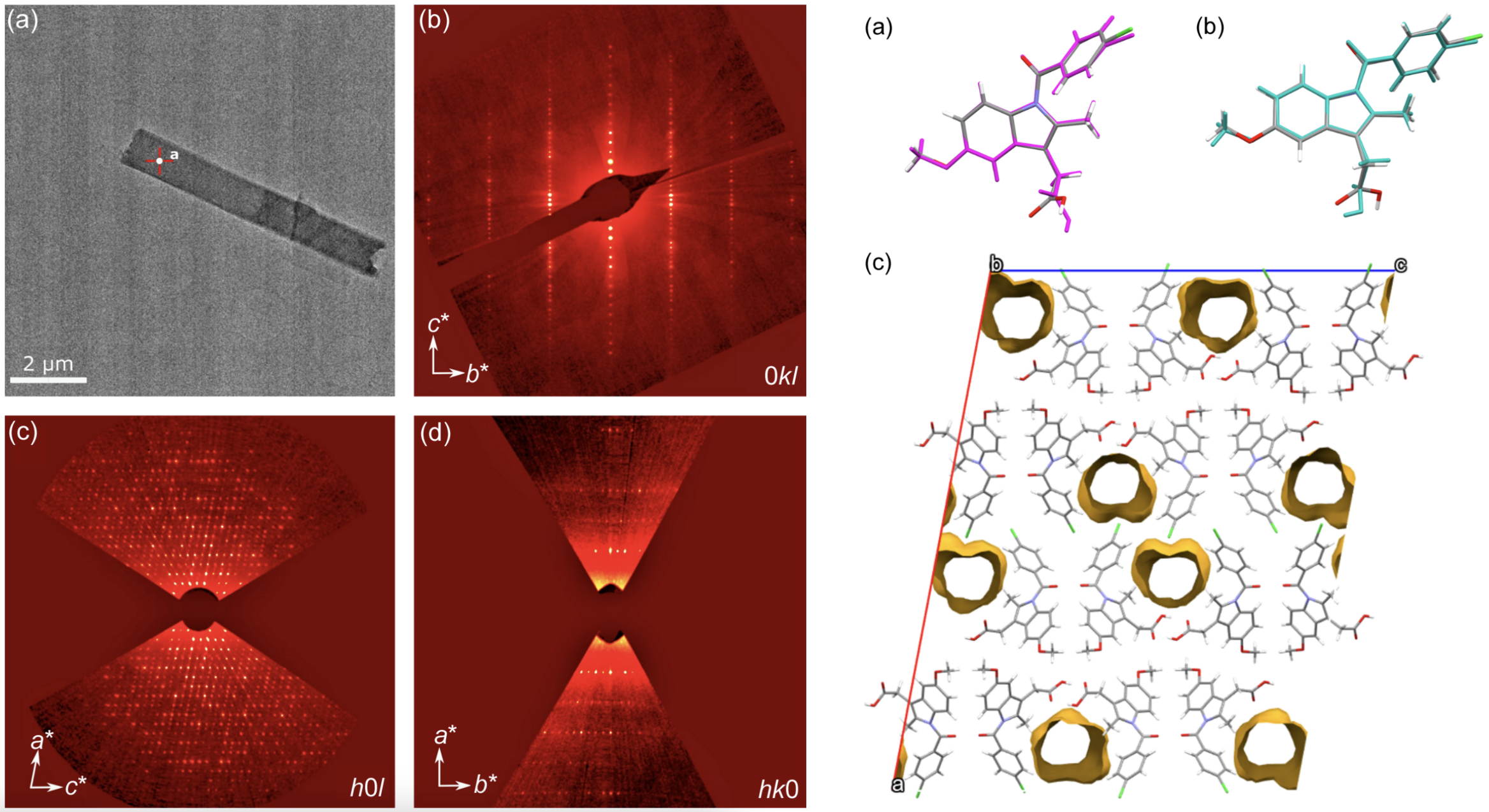
(Left) 3D-ED diffraction patterns taken from our group's recent publication (H. Leung et al. 2024),
showing slices of reciprocal lattice planes of indomethacin. (Right) Structural model σ indomethacin.
Our approach begins with an initial guess of the structure derived from the experimental data. This preliminary model is used to simulate diffraction patterns, which are then iteratively refined. We employ methods adapted from machine learning, including automatic differentiation and parallelized computing, to optimize the structural model. The goal is to converge to the model that best fits the observed data, as measured by the R factor, a quantitative metric for agreement.
Previous Research Topics
Design of a Novel Ultrafast Electron Microscope
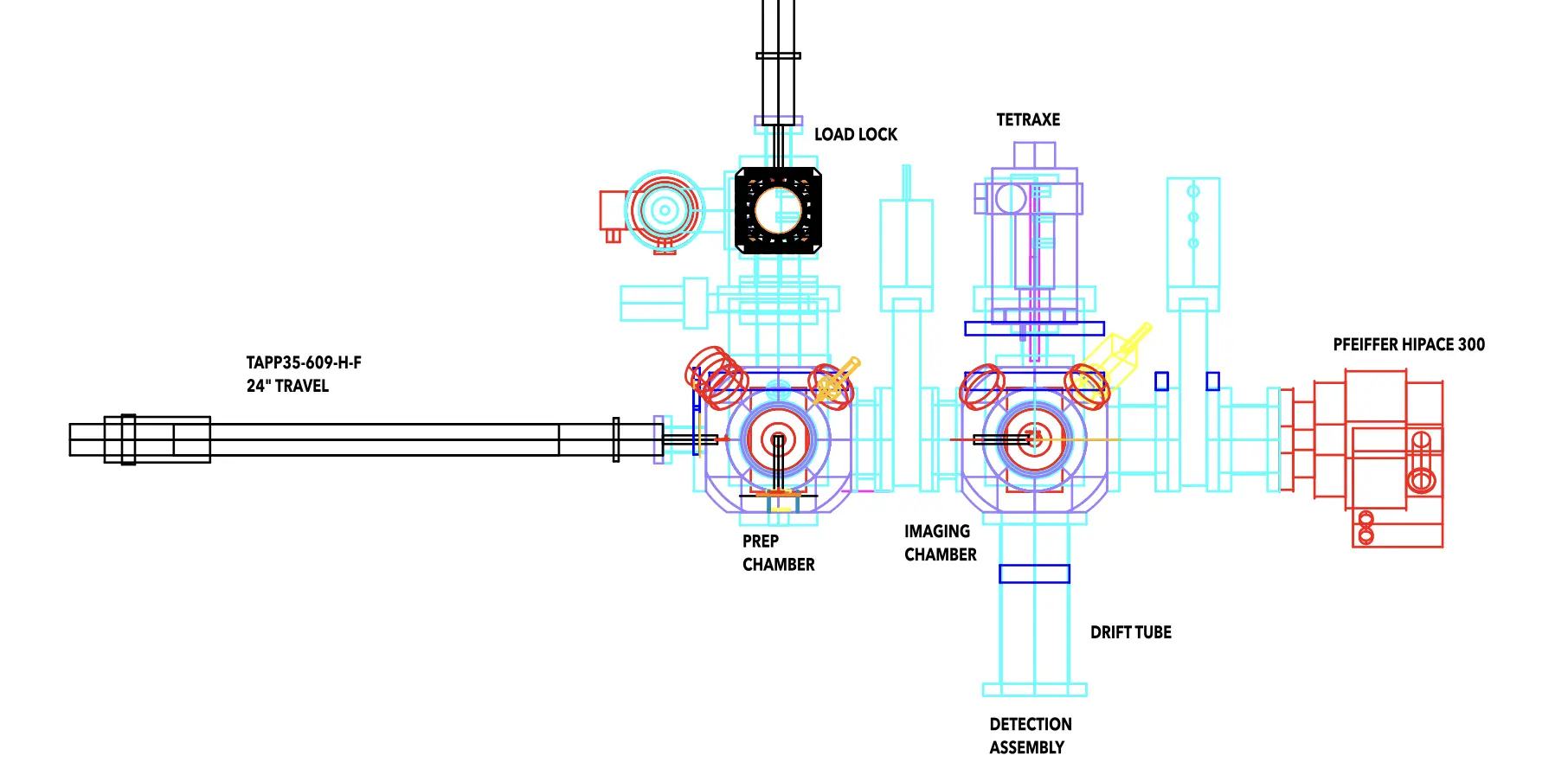
Side view diagram of proposed UHV system, to be built at McGill University
During my time working in McGill University’s Quantum Dynamics Lab (QDL), I was involved in the design of a novel point-projection microscope, to be built by January 2025. The system aims to achieve single-shot imaging with femtosecond (fs) resolution, using coupled THz pulses to drive electron emission from tungsten nanotips. I developed CAD designs for the UHV chamber and load-lock system, optimized vibration isolation, and conducted electron coherence and emission simulations. These efforts lay the groundwork for a state-of-the-art microscope with enhanced stability and imaging precision.
Optimizing Plasma-Based THz Sources for Electron Emission
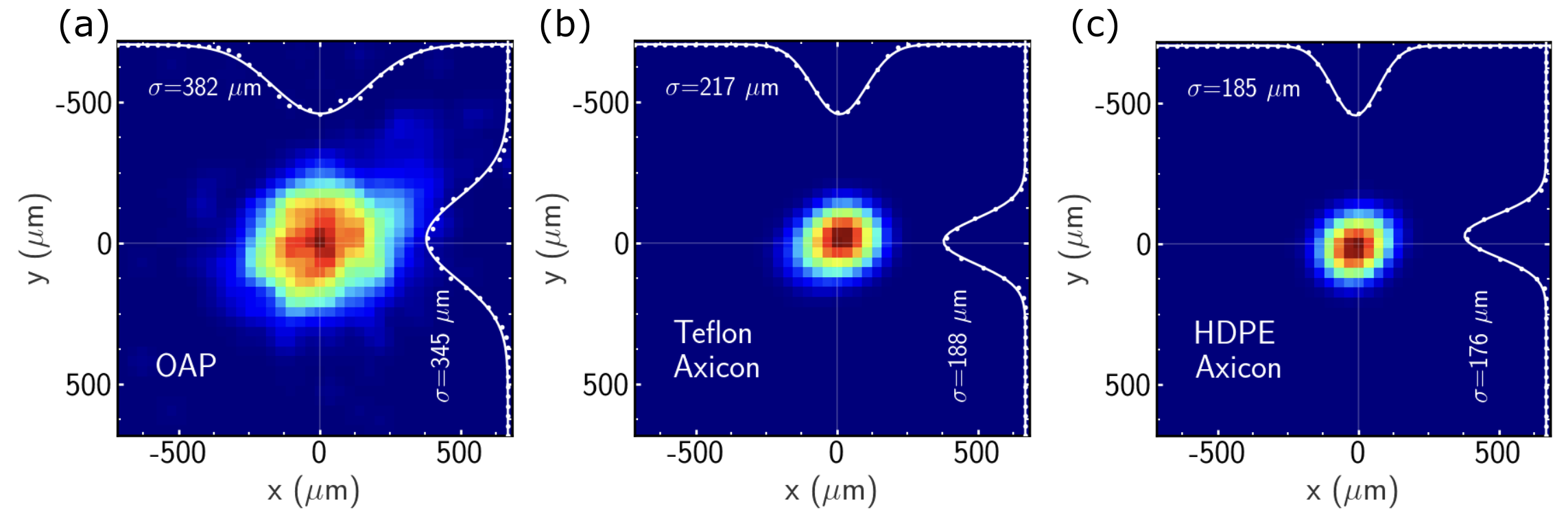
Spatiotemporal spreading effect of THz light focused using plasma-based sources.
One key project investigated during my MSc was the generation and optimization of THz pulses using plasma-based sources, where we discovered a novel spatiotemporal spreading effect when focusing THz light. This finding led to insights into enhancing THz pulse delivery and control, which are crucial for nonlinear spectroscopy applications. In another study, I explored sub-cycle electron emission from metal nanotips driven by intense THz pulses. Our work demonstrated the capability to generate electron bunches with higher energies and charges than previously achieved.
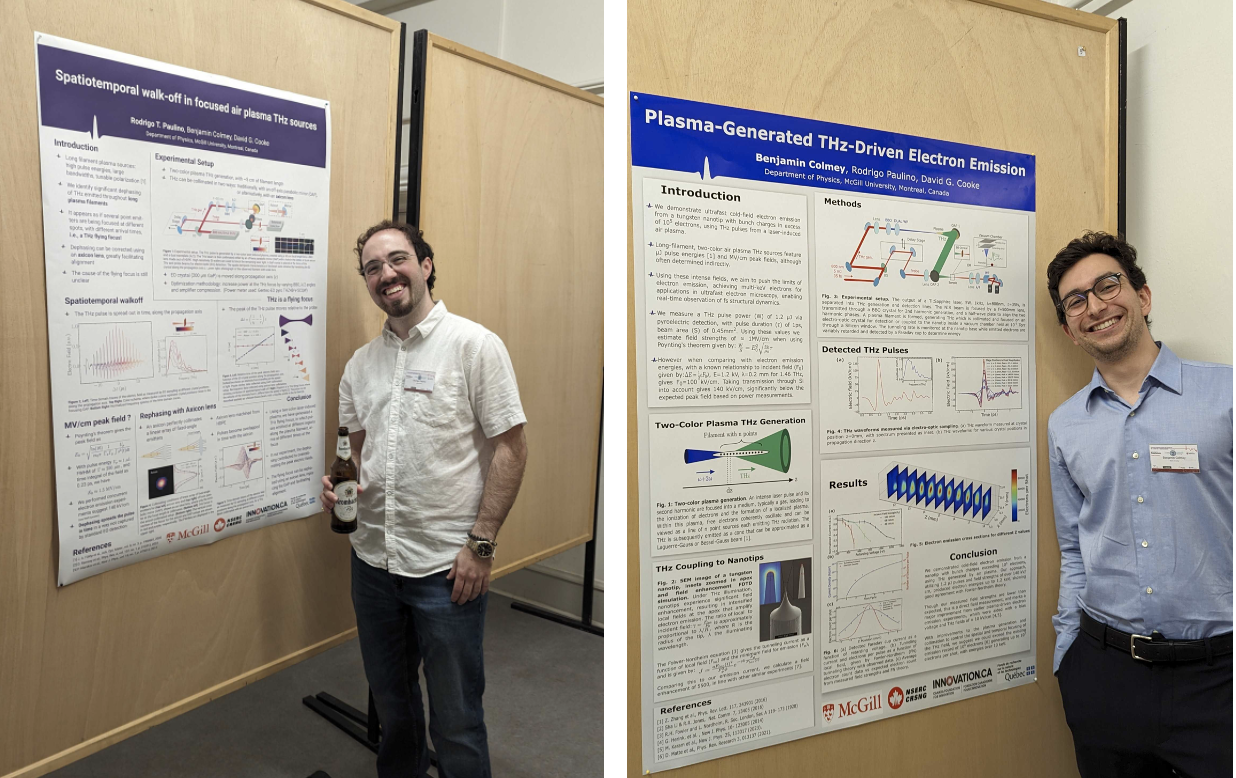
Rodrigo and I presenting our work at OTST 2024 in Marburg, Germany
Publications
-
The role of absorption in 3D electron diffraction dynamical structure refinement
Authors: Benjamin Colmey, S.A. Malik, T.A.S. Doherty, P.A. Midgley
Status: Under review, Acta Crystallographica, 2026 -
Hybrid Physics-Machine Learning Models for Electron Diffraction Refinement
Authors: S.A. Malik, T.A.S. Doherty, Benjamin Colmey, S.J. Roberts, Y. Gal, P.A. Midgley
Published in: Nature Communications, 2026 -
Pseudo-Differential Operators and Fourier Integral Operators in the Gevrey Setting
Authors: Benjamin Colmey, R. Lascar
Published in: Journal of Pseudo-Differential Operators and Applications, 2025 -
Sub-cycle Nanotip Field-Emission of Electrons Driven by Plasma Generated THz Pulses
Authors: Benjamin Colmey, R.T. Paulino, D.G. Cooke
Published in: Applied Physics Letters, 2025 -
Spatiotemporal Walk-off and Improved Focusing of Plasma THz Sources
Authors: R.T. Paulino, Benjamin Colmey, D.G. Cooke
Published in: Optics Express, 2024